
Reading Orange County Deed Records
Deed records in Orange County begin with instruments delivered to the Recorder for permanent recording. Every deed names who conveyed and who received. It describes the land, states the form of conveyance, and carries a recording reference. Deeds form the core paper trail of ownership. Mortgages, releases, liens, and plats can also affect the same tract. They are not deeds.
| Deed Type | What It Does | Common Use |
|---|---|---|
| Warranty deed | Conveys the stated ownership with covenants | Ordinary arm's-length transfers |
| Quitclaim deed | Conveys whatever interest the grantor holds | Family transfers and title cleanup |
| Special warranty deed | Offers narrower covenants tied to the grantor | Transfers with limited assurances |
| Personal representative or trustee deed | Conveys through an estate or trust role | Estate and trust administration |
| Tax deed | Documents a transfer following the statutory tax process | Tax-sale property |
Other claims ride the same index. A mortgage secures debt, a release clears it, and a lien can burden the parcel. Never treat the newest deed as the whole story; every one of those instruments belongs in a complete chain review.
The Orange County Recorder Portal Starts Online
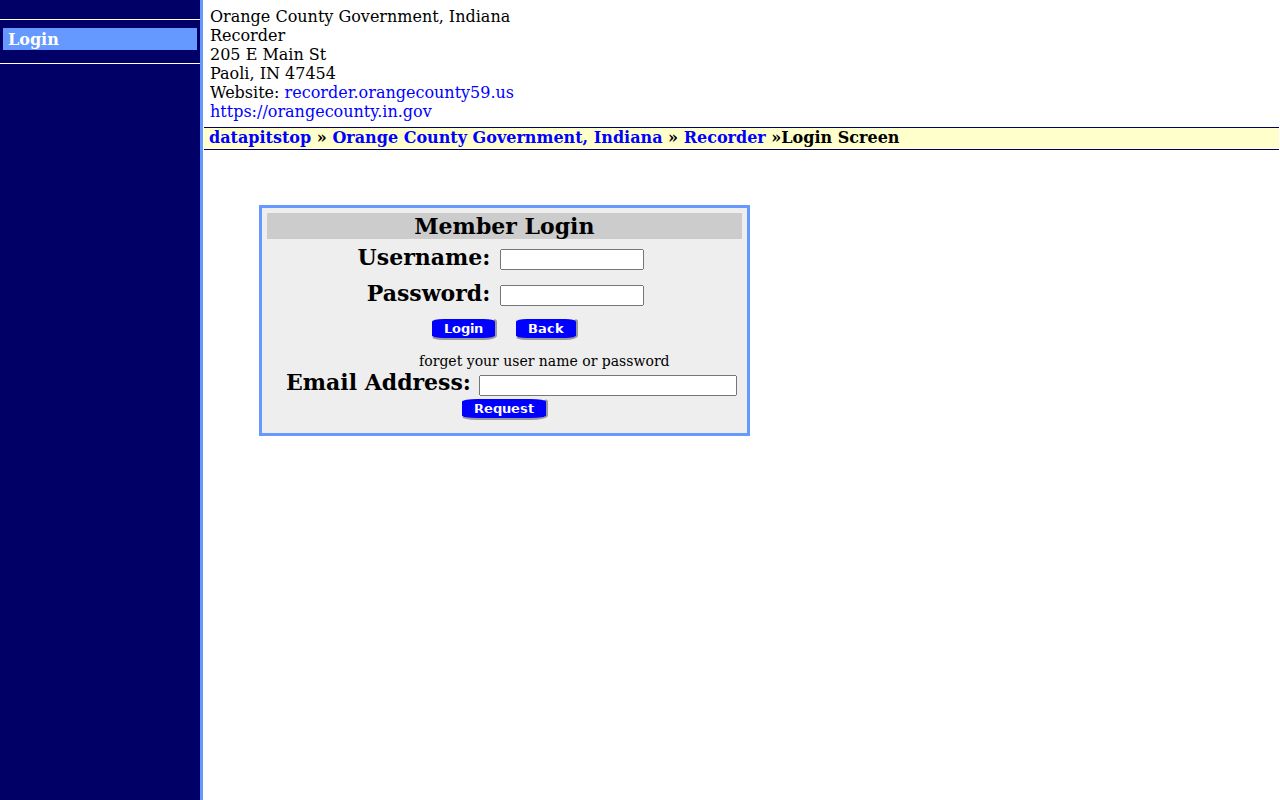
The Orange County Recorder sits at 205 E Main Street, Suite 8, Paoli, IN 47454, and the office phone is 812-723-7114. Its Datapitstop landing page opens with a login screen. No online start year or field list appears. Those limits make the office itself the main access channel, not merely a place to certify a web result. Call or visit before ordering anything. Confirm index coverage, current recordings, available images, book/page or document-number references, copy charges, and certification options with the staff.
Trace Orange County Deeds Through Both Party Indexes
A grantor-grantee index tracks people and entities, not street addresses. Start with the current assessed owner or a document reference drawn from the parcel layer. Search that party as a grantee first. That search finds the deed by which the party received the property, and the grantor name and legal description point to the next step back in the chain.
- Find the current party's acquisition deed with that party indexed as grantee.
- Compare its parcel or legal description with the tract under study.
- Read the grantor, then search that former owner as grantee for the earlier acquisition.
- Repeat until the web index ends, then carry the book/page trail into deed books or microfilm.
- Grantor
- The party conveying an interest.
- Grantee
- The party receiving that interest.
- Chain of title
- The linked sequence of recorded transfers for one tract.
- Book/page and document number
- Two forms of reference used to retrieve a recorded instrument.
Orange County's Deed Microfilm Reaches to 1816
The Indiana State Library's Orange County finding aid lists deed volumes covering 1816 through 1901. Separate grantor and grantee indexes span 1816 through 1887. A general deed index covers 1886 through 1892. Those dates give a concrete path. The current portal stays quiet about its historical cutoff. Older deeds are read by reference, not by street search. Build the chain one party at a time. Record each volume and page, and preserve the legal-description wording exactly. Township, section, lot, and plat clues outlast later postal addresses.
Historic Orange County Plats Can Resolve Old Descriptions
The State Library catalogs Orange County maps, atlases, and plat books from 1901 through 2023. Indiana Memory adds a digitized county plat book. Its map images cover South French Lick, North French Lick, Orleans, and North Paoli. A plat ties a deed's lot or named addition to its mapped setting. Treat the maps as finding aids. They help identify the right subdivision or neighboring landholder. The deed book and recorded plat control.
Estate Transfers May Break a Simple Orange County Chain
Not every Orange County parcel moves by a simple seller-to-buyer deed. Land can pass through an estate, a court order, a trust, survivorship, or a partition. Orange County probate microfilm spans 1816 through 1943, and partition records run from 1853 through 1922. The Circuit Court Clerk holds the county court files.
A grantor may appear with no acquisition deed. Check the instrument type, then look at the related estate or court record. Indiana MyCase can help with newer public case information. Complete files and courthouse terminals remain with the Clerk.
A partition can divide land among interested parties. An estate proceeding can explain the authority behind a later personal-representative deed. Record the case reference, the parties, the land description, and the deed that completed the transfer. Court evidence should clarify the gap in the chain, not replace the recorded conveyance that follows it.
MyCase does not display every document or confidential record. Orange County's converted historical cutoff is not published. If a name search fails, ask the Clerk about the courthouse file and public terminal instead of assuming the event never occurred.
Request an Orange County Deed Copy
Start by gathering the grantor and grantee names. Add an approximate recording date and any document number or book/page reference. Check the portal for access, then contact the Recorder for an image, counter inspection, mail procedure, or certified copy. The office does not publish a copy fee. Get the amount and payment instructions directly. When an index search cannot reach an existing public record, Indiana's Access to Public Records Act, Indiana Code 5-14-3, offers a request route. Inspection is generally free. Copying follows statute and agency schedules, and an acknowledgment does not always mean immediate production.
Recorded is not guaranteed. Orange County deed records show instruments accepted for recording. They are not a title opinion, and unrecorded interests or indexing errors can exist.
Cross-Check the Orange County Parcel Record
A parcel card from the Schneider layer often carries more than a map reference. Sale date, price, deed book and page, and a document number may all appear. That depends on which fields are filled in. The same record adds the owner of record, legal description, acreage, and parcel identifiers. Treat the card as a lead, though. A derivative parcel summary can lag behind a recording or flatten the language of the deed itself. Weigh the recorded instrument as the authority.
For a wider address-to-parcel workflow, the Orange County property search is the better starting point. A deed page stays focused on the instrument itself: its parties and its terms. It also covers the chain of title it creates.
Match legal descriptions, not street addresses. A deed in Orange County may span several tracts, reserve an interest, or lean on a prior instrument. It may also describe the land in words older than the current postal address. Any of those quirks can hide a connection an address match would miss.
Execution date and recording date are separate facts. Record both when they appear. The gap between them explains the lag. A tax roll and a fresh filing do not always move together. Keep the party names spelled exactly as written, too, since the next index search depends on that precision.
When the parcel service gives both a book and page plus a document number, save the pair. One may unlock a courthouse system while the other fits an older volume. Note the parcel number, acreage, and township before moving on. Those details form a compact audit trail. Later, a name search may surface several instruments. A legal description may also lean on unfamiliar wording.