
Trace Orange County Former Owners Transfer by Transfer
A backward chain works like a ladder. Take a known current deed, note who sold, and make that seller your next search name. Repeat until the chain fades. The Orange County Recorder holds the instruments themselves. The parcel layer fills the bridge fields, including deed book, deed page, document number, latest sale date, and the legal description that ties each transfer together.
| Source | Years It Covers | Where Held | What It Shows |
|---|---|---|---|
| Recorder deed index | Current span not verified | Recorder portal and office | Grantor, grantee, and deed reference |
| Microfilm deed books | 1816-1901 | Indiana State Library | Earlier conveyances in full volumes |
| Grantor/grantee indexes | 1816-1887 | State Library microfilm | Name path into historic deed books |
| Partition and probate series | 1853-1922 / 1816-1943 | State Library and Clerk | Transfers outside an ordinary sale |
Start with the latest recorded deed. When the modern index runs out, move to the named historic series. Treat any schema field, owner map, or index line as a lead only. The conveyance itself is what proves the transfer.
Reconstruct the Orange County Deed Chain Backward
This method simply reverses the usual grantor-to-grantee reading. Begin with the present grantee's acquiring deed, then search that instrument's grantor as the earlier grantee, and keep climbing.
- Record the current deed's grantor, grantee, date, reference, and legal description.
- Search that grantor as a grantee before the transfer date.
- Compare lot, subdivision, acreage, or section-township-range wording.
- Repeat the handoff, noting trusts, estates, name changes, splits, and combinations.
- Grantor / grantee
- The conveying party and the receiving party.
- Chain of title
- The linked sequence of instruments affecting the same land.
- Legal description
- The durable land identity when an address or PIN changes.
Find Orange County Former Owners in the 1816-1901 Deed Run
Older Orange County deed records survive on microfilm. A State Library finding aid documents deed volumes from 1816 through 1901, grantor and grantee indexes through 1887, and a general deed index covering 1886 through 1892. This is the main historical fallback. Use it whenever a modern web search ends. Review the Orange County microfilm inventory before requesting an old volume. Cite the series, year, volume, and page whenever you know them.
Coverage check. No official source reviewed gave the modern web cutoff; confirm it with the Recorder instead of substituting the 1816 microfilm date.
Keep Prior Orange County Owners Tied to the Same Land
Old instruments describe land in their own language: lot and block, subdivision plat, acreage, adjoining owners, or section-township-range calls. Copy that wording exactly, including any prior-conveyance clause. Precision matters here. The 18-digit PIN is handy for current navigation. But it can change after a split or combination. For a chain of former owners, the deed description and earlier book and page references are the firmer anchors.
Bridge Orange County Estate and Partition Gaps
Not every interest moves by ordinary sale. An executor deed, trustee deed, transfer-on-death instrument, quiet-title order, or partition can transfer land without a standard conveyance. Both recorder and court records matter. Microfilm listings cover probate records from 1816 through 1943 and partitions from 1853 through 1922. Search the decedent, the heirs, the fiduciary, and the grantee. Match the tract before adding any name to your list of former owners.
Read Rural Former Owners Through Orange County Survey Geography
Rural Orange County descriptions follow the early federal survey. Freeman's Corner north of Orleans and Pivot Point south of Paoli preserve that framework. They explain why old deeds speak in sections, townships, ranges, and quarters instead of road numbers. A historic map can orient the search nicely. It still proves nothing about ownership. For proof, return to the deed, probate, or partition record that names parties and conveys the tract itself.
Reach Orange County Ownership History Online and Off
The Recorder portal requires a login and states no start year or image range for its online records. Open the Orange County Recorder portal to look, and call 812-723-7114 with questions. Staff can explain coverage, courthouse terminals, images, and copies.
- Use parcel data for the current PIN and deed-reference leads.
- Ask the Recorder about its current index and instrument copies.
- Use State Library microfilm for early deed series.
- Ask the Clerk about probate, partition, or property cases.
Indiana's APRA gives the public a direct route. Request a specific existing record, and include names, a date range, the parcel or legal description, and the format you want.
Search Orange County Previous Owners Under Every Name Form
A chain can stall over a name. Surnames shift through marriage, estates act through personal representatives, trusts change trustees, and businesses reorganize. Search every form. Try full names, surnames alone, initials, alternate spellings, trustee wording, and formal entity names. Keep each hit provisional until its deed describes the same land. Grantor and grantee indexes serve opposite sides of one transfer. Tracing backward, the seller who appears as grantor on a deed becomes the grantee you hunt in the earlier period. That inversion turns scattered deed records into a true sequence of former owners. Never silently modernize an old spelling. Record the indexed form, the form inside the instrument, and the form used for the next search. One small transcription difference can hide a prior owner's acquiring deed under an unexpected name.
Connect Orange County Prior Owners to Plats and Old Maps
Maps can carry the chain when streets no longer match. The State Library's collection includes a 1907 Lambdin map that marks property owners. It also holds a digitized Hixson plat book with separate pages for South and North French Lick, Orleans, and North Paoli. These plats can place a surname or a tract in local geography. They still work after street names have shifted. They do not replace the deed records. Open the State Library's Orange County map and plat-book guide to inspect its dated inventory.
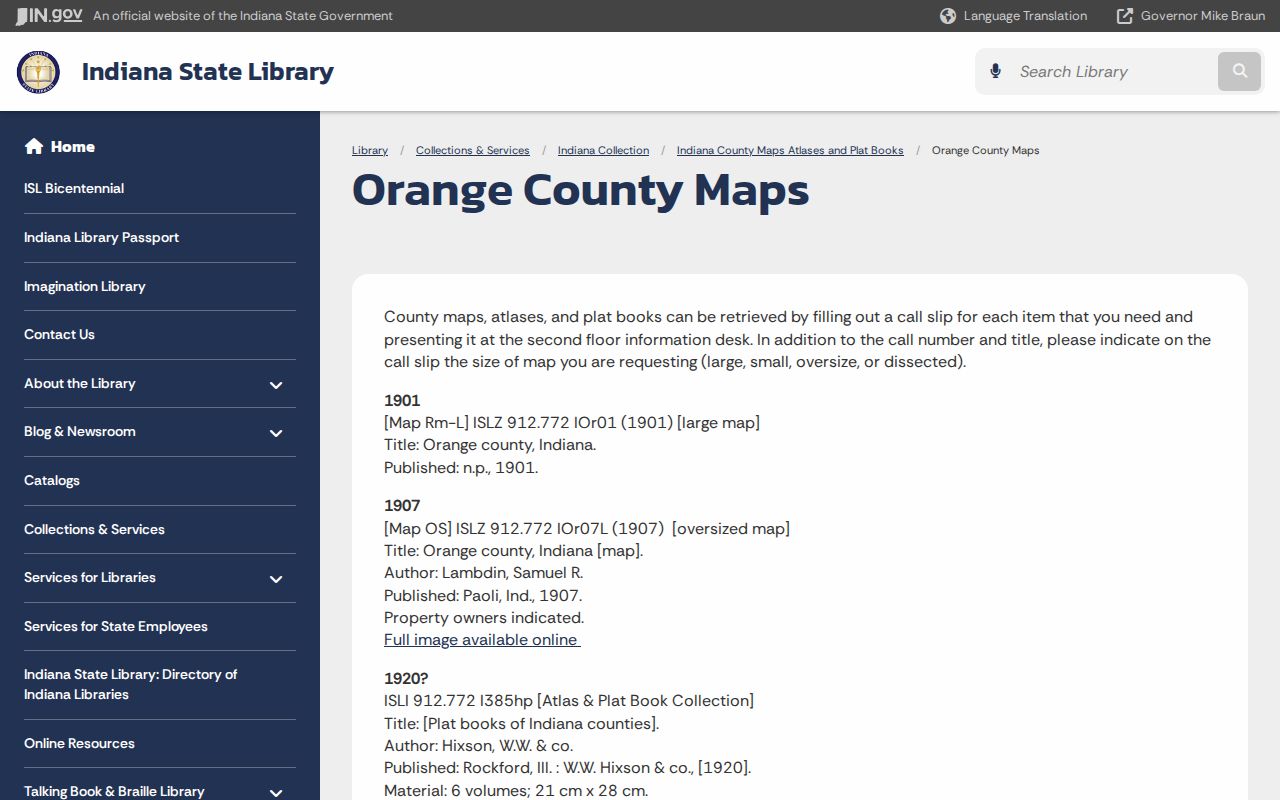
The collection guide is a geographic lead, nothing more. Each apparent name or tract still needs confirmation in a deed or related legal record. French Lick and West Baden also appear in 1925 Sanborn material. Building footprints and historic use can clarify which parcel or lot an old source describes. A map label alone establishes no conveyance. Confirm every link in the deed book. Confirm it in the plat, the probate file, or a court record. Orleans offers the clearest warning. Congress Square began in the original 1815 plat. It later held a school, then a park, while nearby buildings changed after an 1897 fire. A present-day open space can therefore demand records tied to old numbered lots. It may need civic-use records rather than a normal sequence of prior owners.
Keep an Orange County Former-Owner Research Log
Log every transfer as you go. Each entry should capture the instrument date, recording date, grantor, grantee, deed type, book and page or document number, and the legal description. Also note the source and any uncertainty you noticed. A careful log turns a gap into something visible. It stops a smooth narrative from papering over missing deed records.
When a tract was divided, record both the parent and child parcel numbers. Acreage changes deserve a close look too. Compare what each instrument actually conveyed rather than assuming the whole parent parcel passed. A "being the same premises conveyed by" clause is a gift. It points straight to the prior deed. Copy it into your notes whenever it appears.
Orange County's historical land trail runs across several layers. Modern GIS maps sit beside current instruments, older book-and-page references, and microfilm terminology. Move deliberately between them. That keeps the history of a nearby lot or leftover tract from attaching itself to the parcel you are tracing.
Know How Far Orange County Ownership Records Go
Orange County deed books trace ownership back to the county's 1816 founding, though the oldest volumes sit in archives rather than online indexes. Whenever you move from parcel data to a deed book, microfilm reel, or court file, write down the citation. That small habit keeps a clear trail back to the owner of record.
Lawful use. Ownership history supports house research and property diligence; never use a living person's record to harass, intimidate, or cause harm.